You design the future. We help you make it happen.
Montena Technology - MIL-STD-461 Test System, CS116, CS115, CS114
- Automatic calibration for the whole test frequency range
- Application of all test frequencies automatically. The level can be selected or automatic.
- NO need to manually configure the measurement equipment
- NO need to manually integrate the transfer function of probes and attenuators
- Generation of test reports: NO need to record all values read from the measurement equipment
- Generation of calibration reports: NO need to record all calibration setting parameters
- Rack together and add CS101, CS109, and RS101 (sections 18, 19, and 20 of the RTCA DO-160G are also available.)
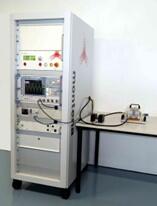
TS-CS114-CS115-CS116 TurnKey Test System for MIL-STD-461 Options of CS106, CS101, CS109, RS101 + Relivent DO-160 tests
Introducing the CS114 / CS115 / CS116 Test System by Absolute EMC – a comprehensive solution engineered to meet the rigorous requirements of MIL-STD 461 D/E/F/G standards. This versatile test system is designed to verify the transient conducted susceptibility of Equipment Under Test (EUT) across various frequencies and excitation methods, ensuring the reliability and resilience of your naval and industrial electronic systems.
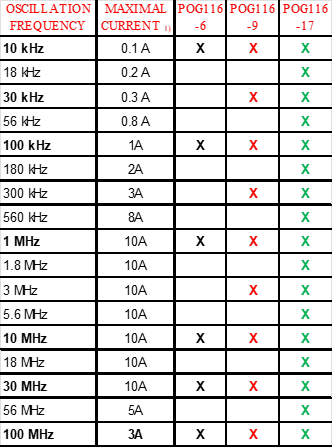
The CS116 damped sinusoidal pulse generator provides up to 17 test frequencies (instead of the minimal 6 frequencies required by the standard). This allows a better excitation of the resonances of the equipment under test.
Key Features
- Comprehensive MIL-STD Compliance:
- CS114: Conducted susceptibility, bulk cable injection, 4 / 10 kHz to 400 MHz.
- CS115: Conducted susceptibility, bulk cable injection, impulse excitation.
- CS116: Conducted susceptibility, damped sinusoidal transients, cables and power leads, 10 kHz to 100 MHz.
- Flexible Frequency Configurations:
- CS114 Setup: 4 / 10 kHz – 400 MHz.
- CS115 Generator: 0 to 1 kV (on 50 ohm), Trise ≤ 2 ns, pulse duration ≥ 30 ns, Tfall ≤ 2 ns.
- CS116 Generator:
- Standard: 6 test frequencies.
- Optional: 9 or 17 test frequencies for enhanced resonance excitation.
- Efficient Testing Process:
- Single Signal Output: No need to change connections during tests, reducing test duration and minimizing human error.
- Integrated HF Switching Capability: Enables seamless calibration and measurement across CS114, CS115, and CS116 without reconfiguring cabling.
- Automated Calibration and Test Sequences: Streamlines operations and ensures consistent, repeatable results.
- Comprehensive Accessories Included:
- Standard Package: Coupling clamp, current probe, attenuators, resistive load, oscilloscope, and control software.
- Optional Accessories: Injection probe, attenuator, oscilloscope, and additional modules for specific testing needs.
- User-Friendly Control:
- Computer Integration: Fully controllable via RS232 and USB interfaces for seamless integration with your existing testing infrastructure.
- Automation Software: Dedicated application for automatic calibration, setting perturbation levels, data collection, and report generation.
- Robust and Reliable Design:
- Power Compatibility: Operates on 90 – 250 Vac / 50 – 60 Hz, accommodating a wide range of power environments.
- Durable Construction: Designed for long-term reliability in demanding testing environments.
- Compact Dimensions:
- 19" Cabinet Version: 1600 x 600 x 800 mm, weight approximately 170 kg.
- Rack Module: 630 x 485 x 405 mm (9HU), weight 17.0 kg.
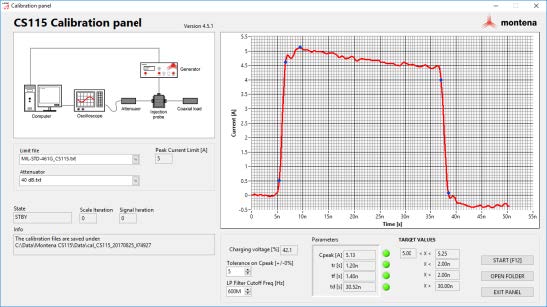
The proposed system is unique in the market. It has been optimized to ease the test procedure, to reduce the risks of human errors, and to save testing time. Its unique features are:
One single signal output
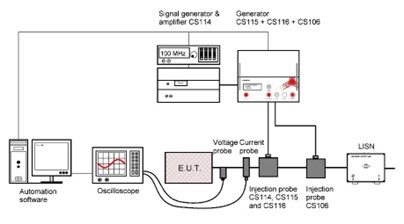
The generator has one signal output for the CS115 square pulse, for all CS116 discrete test frequencies as well as for the CS114 signal received from the external amplifier. The calibration or the measurement phase can be performed without any need to change the cabling nor to exchange modules.
Menu-driven control panel
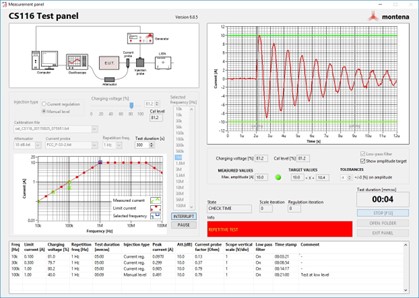
The menu-driven control panel allows the user to select the desired discrete frequency, the pulse voltage level, the repetition rate, and the number of pulses to be generated.
Remote controlled
The generator (like all generators from Montena) can be remote-controlled through its RS232 or USB interfaces. Montena proposes a dedicated software application for the automation of the tests.
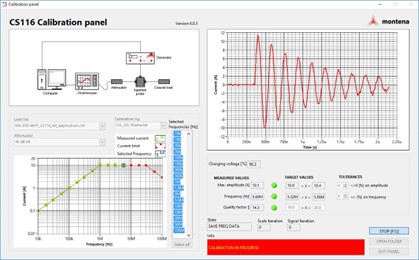
- Automatic calibration for the whole test frequency range
- Application of all test frequencies Level can be selected or automatic
- NO need to manually configure the measurement equipment
- NO need to manually integrate the transfer function of probes and attenuators
- Generation of test reports, NO need to record all values read from the measurement equipment
Generation of calibration reports, NO need to record all calibration setting parameters
CS116 test frequencies (options to increase test frequency up to 17)
The MIL-STD-461 CS116 requires testing the susceptibility at 6 discrete frequencies between 10 kHz and 100 MHz. Montena's CS116 generator optionally provides additional frequencies to:
CS114 test setup
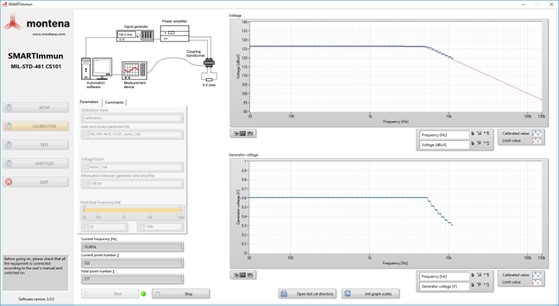
Measurement with oscilloscope and FFT
The test setup comprises a digital oscilloscope for the measurement of the injected signal. For the CW signal of the CS114 test, the control software reads the measured signals and performs the FFT (Fast Fourier Transform) to extract the injected signal frequency from the ambient noise. The use of the FFT allows much better sensitivity than competitive solutions using power meters or measuring the peak signal voltage with an oscilloscope.
SMARTImmun automation software
The CS114 test setup is supplied with the new SMARTIMMUN control software.
Optional CS114 extension for ships and submarines testing
This extension enables tests starting from 4 kHz instead of 10 kHz, to cover the new MIL-STD-461 F/G CS114 common mode injection requirement of 77 dBmA that is applicable from 4 kHz to 1 MHz on complete power cables.
Prâna amplifier proposed in the basis offer is specified from 10 kHz but, when combined with Prâna 4kHz adaptor module and Prâna injection probe, it delivers enough current from 4 kHz without saturation. This cost-effective solution eliminates the need of a second amplifier for CS114 tests below 10 kHz.
This test uses the waveform generator (0.1 Hz - 25 MHz) that is embedded in the proposed oscilloscope
CS106
The POG-CS116 pulse generator optionally comprises an internal module to deliver the CS106 pulses. Due to the low-frequency content of the CS106 pulse, the injection is performed with a dedicated injection probe.
The measurement is made using the same oscilloscope for all CS106, CS114, CS115, and CS116 current injection tests.
AS-CS115-CS116 System:
|
Model |
Description |
|---|---|
|
POG-CS116-6 |
Pulse generator for MIL-STD-461 D/E/F/G CS116, 6 test freq., 19" rack version. |
|
SW-CS-DOW |
Control software for MIL-STD-461 CS116 test setup |
|
M-CS115 |
Module for MIL-STD-461 D/E/F/G CS115, built into POG-CS116 generator |
|
SW-CS115 |
Test control software application for MIL-STD-461 CS115 |
|
HOUSING-9U |
Instrument case for standalone use of the POG-CS116 generator, 9HU, 520mm |
|
IPDR250 |
Injection probe, 10 kHz – 400 MHz, 500 W, internal diameter 43 mm |
|
CJDR250 |
Calibration jig for the injection probe IPDR250 |
|
8705C |
Current probe, 10 kHz – 400 MHz, 15 A peak, CW: 4 A RMS, max EUT current (DC / 50Hz): 5 A / 20 A, aperture 50.8mm, for MIL-STD 461 CS114, CS115, and CS116 |
|
Set of coaxial load and attenuators |
1 x Diconex 17-3874MON: load 25 W, connector N(m) special version for HV pulses 1 x Diconex 16-6805IMP: attenuator 40 dB, 25 W, N(m) – N(f), for >2.5 KV pulses 1 x Diconex 16-6573: attenuator 10 dB, 2 W, connectors N(m) – N(f) |
|
Cables and accessories |
|
|
RTM3004 |
Rhode & Schwarz, Oscilloscope 500 MHz, 10-bit, 4 channels, 2.5 GS/s (or similar) |
|
TT-SX 9001 |
Differential Voltage Probe |
|
Online training |
1-day (2 half-day) online training given by one engineer from Montena. The training covers the system installation and the test procedure. |
AS-CS114 Upgrade:
|
Model |
Description |
|---|---|
|
M-CS114 |
Module to drive the output of the CS114 amplifier to the common injection probe |
|
Rigol DSG815 |
RF Signal generator, 9 kHz to 1.5 GHz |
|
VBA 400-110 |
Power amplifier 110 W, 9kHz - 400 MHz, with integrated directional coupler |
|
4kHz CS114 Kit (ZF22102) |
For tests from 4 kHz up to 1 MHz (extension for ships and submarines testing), including: 1 x IPDR-AD4KHZ Prâna impedance adapter module for IPDR250 injection probe 1 x Diconex 16-6573: attenuator 10 dB, 2 W, connectors N(m) – N(f) 1 x Coaxial adapter BNC(m)-N(f) |
|
Pearson F-3 |
Calibration fixture for the current probe 8705C |
|
SMARTImmun-CS114 |
SMARTImmun base software application for MIL-STD-461 CW immunity test, lifetime license for 1 computer, SMARTImmun license option for MIL-STD-461 E/F/G CS114 |
AS-CS106 Upgrade:
|
Model |
Description |
|---|---|
|
M-CS106 |
Module for MIL-STD-461 F CS106, built into the POG-CS116 generator |
|
IC10M |
Injection probe for MIL-STD-461 CS106, aperture 34 x 43 mm |
|
R5-2-400 |
Precision resistor 5 ohm from MIL-STD-461, CS106 calibration setup |
|
SW-CS106 |
Test control software application for MIL-STD-461, CS106 |
More Product Information
AI, cloud computing, and hyperscalers are accelerating the demand for ultra-high-speed, low-latency connectivity, taking us past Gigabit Ethernet and into the era of Terabit Ethernet.
Teledyne LeCroy’s Terabit Ethernet solutions are engineered to help you take full advantage of this new technology cycle. The Xena Ethernet Test Platform gives developers of semiconductor, NEMs, and hyperscalers the solutions they need to validate next-gen silicon, network devices, and interconnects with confidence.
From Layer 1 signal integrity and Layer 2 traffic generation and analysis, we have the solutions you need to simulate, stress, and certify real-world performance. Support for 224Gbps electrical lanes, advanced FEC, and PCS diagnostics ensure readiness for tomorrow’s networks. Compact, desktop-friendly hardware combined with intuitive software and powerful automation ensure seamless lab-to-production workflows.
Whether you’re path-finding 1.6T or optimizing 800G deployments, Xena can fast-track your innovation cycle. Test smarter, deploy faster and reap the rewards.
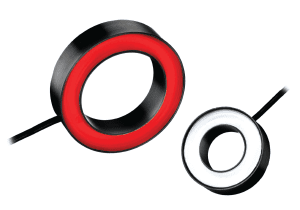
- Extremely bright, compact and reliable
- Chip-on-board technology
- Superior uniformity
- Seamless integration and mounting
ProPhotonix SpecBright™ LED Ring lights are the brightest LED illuminators in their class. These LED Lights are designed and manufactured with a high LED packing density and excellent thermal management for optimum brightness and uniformity.

Very useful where space is restricted, the EMC chamber EMC-MC will settle into almost any office space. Its small overall size results from the use of our modular SmartShield chamber lined with our AEPH HyPyr-LossTM absorber technology requiring less volumetric space than in a traditional chamber. This mini compact EMC chamber is applicable in EMC pre compliance and general Research & Development RF testing.
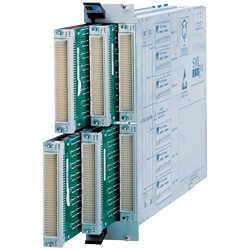
The SMP5xxx product family is made up of the SMP5001 through SMP5005 general purpose relays.
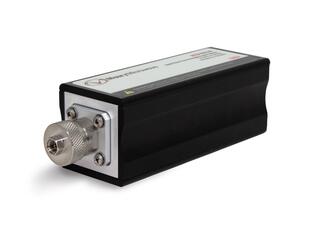
- 4 kHz to 6 GHz and 10 MHz to 6, 18, and 40 GHz power sensors
- -60 dBm to +20 dBm dynamic range
- Pulse, Average, CW and Modulation modes
- True average measurements with essentially no modulation bandwidth limitations
- Real-Time Power Processing™ technology for virtually no gaps in signal acquisition and zero measurement latency
- 100,000 measurements per second
- Synchronized multi-channel measurements
- Suite of advanced measurement and analysis software
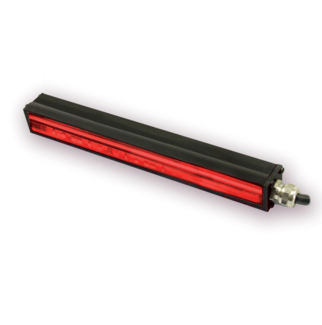
- Part of the MicroBrite™ family of high performance, compact machine vision lights.
- This line light series utilizes a fresnel lens for a compact form factor.
- Provides an intensity level of 189kLux (working distance of 75mm)
- Expandable in 50mm increments up to 750mm
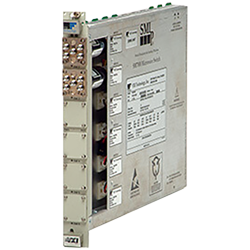
The SM7000 Series microwave switching modules are members of the VXI Technology SMIPII™ family. They offer a modular design allowing custom switching configurations to be easily assembled and modified in the field.
The SM7000 is a single-wide, C-size VXI module, which can support up to six different microwave switches including: a dual SPDT; SP3T through SP6T; transfer switches and passthrough adapters that allow the module to control up to eight externally mounted relays each.
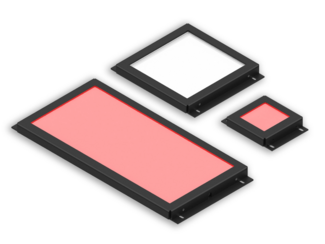
- Part of the MicroBrite™ family of high performance, compact machine vision lights.
- The edge-lit design provides the highest flux density of any backlight in our portfolio.
- Ultra-thin profile for installations with demanding space limitations.
- Available in 3 sizes with a multitude of available wavelengths.
- Base Model numbers include BT050050, BT200100, BT100100
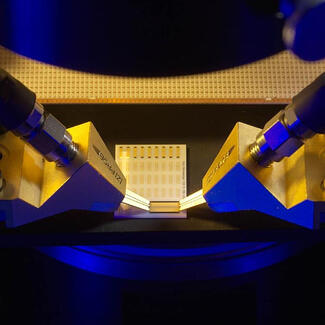
-
Replace costly and inflexible test fixtures with easy-to-use probe tips
-
Long lifetime – typically over 1,000,000 contacts
-
GS/SG footprint up to 4 GHz and GSG up to 20 GHz
-
High-power RF test: up to 30 Watts
-
Test at temperatures from -60°C to 200°C

Absolute EMC
Website
Absolute EMC LLC is a premier North American provider of electromagnetic compatibility (EMC) expertise and test equipment. They deliver end to end consulting—covering IEC, MIL STD, CISPR, and automotive standards—hands on training for all EMC and RF test instruments, and turnkey test system design and integration. Leveraging decades of experience with every major manufacturer and the latest technologies, they also offer strategic guidance on equipment selection, market trends, and procurement to help you maximize the performance and ROI of your EMC investments.