You design the future. We help you make it happen.
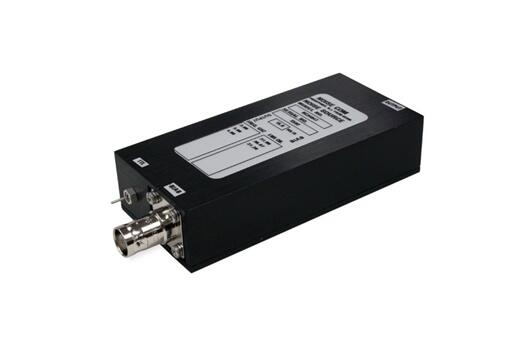
Maury MW - Calibrated Noise Sources - NC3400 Series
- Ideal for applications requiring high ENR and immunity to large incident RF power
- Low VSWR
- Built-in isolator
The NC3400 Series coaxial AWGN noise sources are an excellent choice for applications requiring high ENR and immunity to large incident RF power, such as ATE, radiometer, and radar systems. The calibration accuracy and flatness of the NC3400 Series noise sources are enhanced by their low VSWR. The built-in isolator provides almost constant output impedance as the noise source bias is switched on and off. The isolator also protects the noise diode from incident RF power (consult the factory for higherpower units).
An SMA female connector is standard for the RF output and a BNC female connector is standard for the bias input. Other connectors are available as options.
|
ENR |
VSWR |
Standard Input Voltage |
Noise Output Rise and Fall Times |
Maximum Incident RF Power |
Typical Current |
|---|---|---|---|---|---|
|
Up to 35 dB |
Less than 1.3:1 |
+28 VDC |
Less than 1 µs | 1 W average, 100 W peak | 12 to 15 mA |
Applications
- Radar systems
- High NF device measurements
- Automated test equipment (ATE)
- 802.11ac Wi-Fi
More Product Information
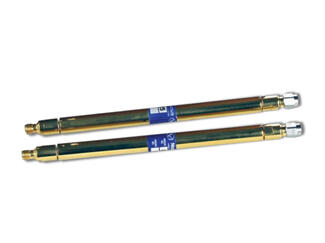
- Calibration-grade metrology standards
- Used for VNA calibration and/or calibration validation
Maury mismatch airlines have been designed as verification standards to be used in VNA calibration validation. Each mismatch airline is provided with factory S-parameters data that can be compared with user-measured S-parameters for VNA calibration validation. Measurement uncertainty is also provided, and uncertainty boundaries can be used for definitive calibration validation when used in conjunction with MT940B Insight Real-Time Uncertainty Add-On.
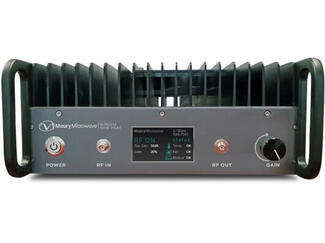
Not all amplifiers are created equal, so how can you be certain that an amplifier will work for your needs? You deserve to be confident that the amplifiers used with your test-and measurement lab benches will meet the requirements of your specific applications, are reliable, and are equally well-supported pre-and post-sale. When it comes to application expertise, reliability and support, there is no company that does it better than Maury.
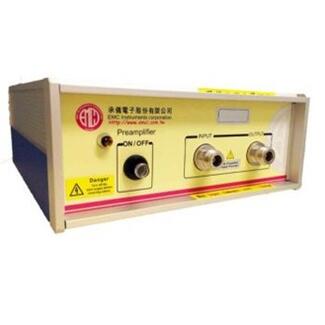
- 1 - 6 GHz, 40dB Gain, 2.5dB N.F.
- Compensation long cable loss for EMI Measurement
- Improve system noise floor flatness
- High EMI performance
- High linearity LNA for EMI measurement
- High dynamic range
- Unconditionally Stable
- State-of-the-Art Technology
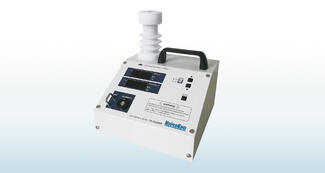
The ESD voltage meter MODEL: 18-00086B is a device that can measure the voltageholding time (holding voltage after 5 seconds) and output
specifications during the air discharge test in IEC 61000-4-2.The measured voltage is displayed on a 7-segment LED with peak and holding voltage values.
- Easily measure the Hold Time, the tester specification for air-discharge testing.
- Measure the output voltage from ±2kV to 30kV.
- Monitor the measured voltage waveform by connecting to an oscilloscope.
- Compact, lightweight and easy to carry.
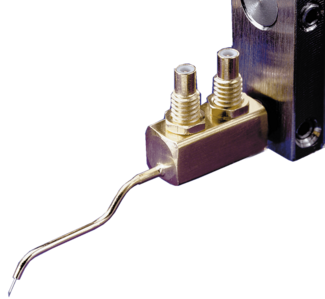
- High-quality construction with low-noise electrical performance
- Kelvin version for convenient 4-point measurements
- Replaceable coaxial probe tips, with choice of tip radii, and full electrical guard to the probe tip
- SSMC 50 connectors
- Ultra-low, fA and fF measurements from -65 º C to 150 º C
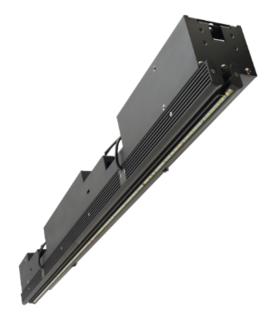
- High speed 60 kHz x3 (Color) or 120 kHz (Mono), and high resolution 28 μm or 900 dpi
- No missing or interpolated pixels
- Exposure control
- RGB colors (Color) or Mono/HDR mode
- Precalibrated pixel size for metrology applications
- Camera Link HS fibre interface
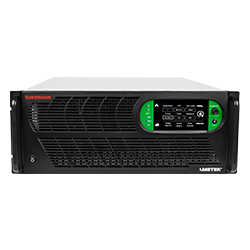
- Complete solution - battery test, simulation & solar array simulator software included
- Highest power density up to 37 kW in 4U rack height (9.25 kW/U)
- Fastest and cleanest power available (fastest transient response and low output ripple and noise)
- Universal 3-Phase AC Input accepts 180 VAC to 528 VAC
- Longest manufacturer-based reliability guarantee: 5-year warranty
- Parallel system power up to 1.2 MW
- Output voltage up to 2,000 V
- Bidirectional output current up to ±150 A, up to ±4,800 A in parallel
- True extended wide-range autoranging output
- Regenerative to 95%
- Color touch panel user interface
- Seamless transition between source and sink
- Built-in islanding detection
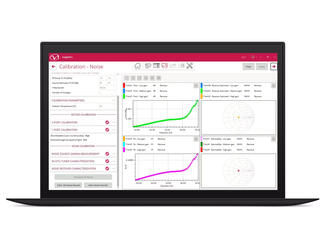
- Flexible bench configuration empowers users to easily set up instruments and DUTs to match any measurement workflow.
- Automated, multi-instrument calibration workflows empower users to achieve high accuracy results across diverse setups with minimal user intervention.
- Built-in system calibration verification instills confidence in measurement accuracy before data collection begins.
- Comprehensive small-signal, large-signal, and pulsed testing captures real-world device behavior for reliable design and modeling.
- Powerful visualization and analytics suite empowers users to quickly interpret results, extract models, and drive faster design decisions.
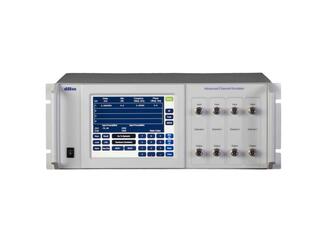
- 600 MHz of instantaneous bandwidth per channel
- Timing synchronization up to 16 channels
- Link Emulation including:
- Phase continuous delay, Doppler, and attenuation changes
- AWGN and Eb/No
- 12 tap (path) multipath fading with Rayleigh, Rician & CW. Angle of Arrival (AOA), k-factor, and correlation controls
- RF frequency agile up/down converters
- Payload Emulation including:
- IMUX/OMUX amplitude and group delay distortion
- Amplifier Compression (AM/AM and AM/PM)
- Phase Noise
- Static and dynamic link emulation
- Ephemeris data generation using SATGEN
- Remote instrument control through ACEClient application

Maury Microwave
Website
Maury Microwave is a pioneering leader in the design and manufacture of precision RF and Microwave calibration, test & measurement, and modeling solutions that are powering global efforts toward a more secure, more connected, future.
Maury Microwave offers Measurement and Modeling Device Characterization Systems and Services including nonlinear passive, active and hybrid-active fundamental and harmonic load pull, non-50Ω X-Parameter modeling, pulsed IV Pulsed s-parameters and compact transistor modeling, and patent-pending ultra-fast/accurate noise parameters.