You design the future. We help you make it happen.
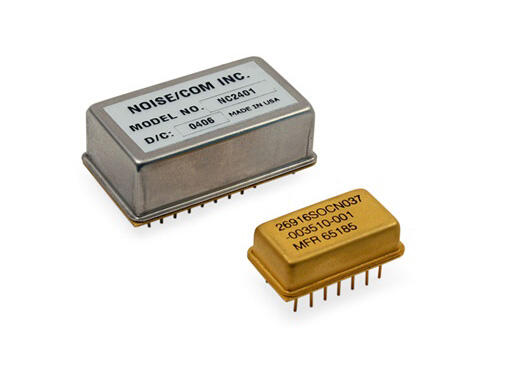
Maury MW - Amplified Noise Module - NC2000-4000 Series
- High-level noise modules mounted on a circuit board
- Modified BW, output power, and flatness specifications
The NC2000 Series amplified noise modules are an excellent choice for high-level noise modules mounted on a circuit board. The NC2000 Series modules are housed in 24, or14-pin dual-inline packages. The NC4000 series modules are housed in a 40-pin module that cover similar noise bands to the NC2000, but have higher crest factor, and 60 dB of TTL controlled attenuation. Modified BW, output power, and flatness specifications are available for these modules. Please consult Noisecom for availability, and appropriate package style.
|
Output |
Minimum Power Output |
Crest Factor |
Flatness |
|---|---|---|---|
|
White Gaussian noise |
25 dB ENR (-143 dBm/Hz) min |
5:1 |
+/-3dB |
Applications
- Dither circuitry for A/D converters
- Communications jamming
- PCIexpress jitter applications
- Built-in test equipment (BITE)
Document
More Product Information
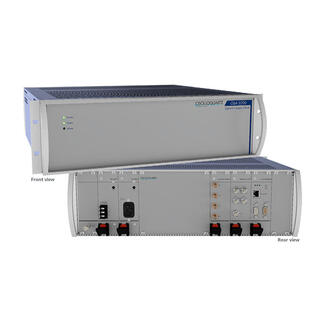
- Uses modern optical pumping instead of older magnetic cesium methods, which improves long-term stability and reliability while measuring many more atoms for highly accurate timing.
- Offers excellent frequency accuracy (≤ ±1×10⁻¹²) and very low phase noise on multiple frequency outputs (5 MHz, 10 MHz, 100 MHz), making it suitable for precise synchronization.
- Supports multiple power options (AC, DC ±24 V, DC −48 V) with redundant and hot-swappable supply modules and optional battery backup for one hour, aiding uptime in critical environments.
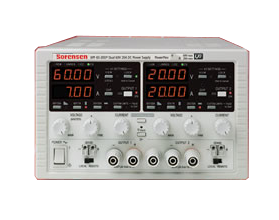
- PowerFlex design provides higher currents at lower voltages enabling one model to meet many different voltage/current requirements.
- Compact design for bench use or rack mounting (1/2 or 1/4 rack width)
- True analog controls with digital settings locking (S-Lock)
- Mixed-mode regulation with linear final regulation for low noise
- Dual models have isolated voltage tracking and synchronous on/off.
- P models have RS-232, USB, and LXI-compliant LAN interfaces plus duplicate rear terminals. GPIB Optional.
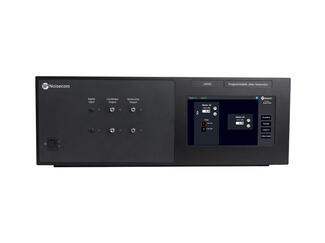
- Ultra-low distortion signal path
- Standard connectors SMA female
- 7” touch screen display
- Dimensions: 17.22 in. wide x 6.30 in. including feet, high x 19.5 in. deep
- Fold-down feet for bench top use
- Power 115 VAC, 60 Hz
- Operating Temperature: -10° to +65°C
- Differential inputs and outputs
- Multiple differential inputs and outputs
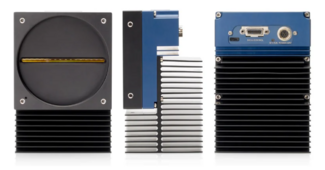
The all new Linea HS™ delivers line rates up to an incredible 400 kHz at 32k resolution — over 13 Gpixels/sec via CLHS interface. With up to 128 TDI stages (plus an extra 64 in HDR mode) for unmatched sensitivity and incredibly low noise, Linea HS excels in the highest speed, lowest light applications.
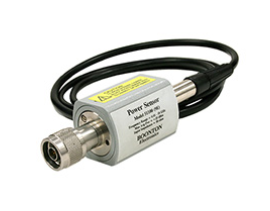
The overall performance of a power meter dependents on the power sensor employed. Maury has a variety of quality power sensors to meet virtually all applications. Maury has a complete line of Peak and Average power sensors up to 40 GHz for all of your fast rise time, wide bandwidth and wide dynamic range applications. In this document, browse through our large variety of advanced sensor solutions.
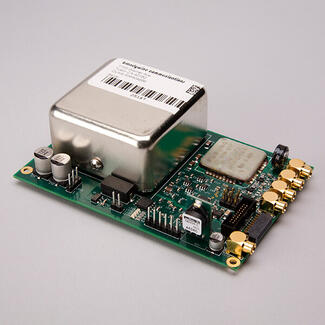
- 3 isolated low phase noise 10MHz outputs
- Internal GPS Tracking Receiver
- External 1 PPS input
- Small footprint designed for easy integration
- Disciplined high stability OCXO

Reproduces transient voltage surge phenomena generated in a vehicle and evaluates the immune resistibility of DUT against the surge. The output waveforms are five as high-repeating pulse, giant pulse, field decay pulse, trapezoidal waveform + high-repeating pulse and high repeating pulse + giant pulse.
- Custom electrical testing available upon request
- Wide package variety with custom configurations
- NC100 & 200 series for audio and RF applications
- NC300 & 400 series for microwave application
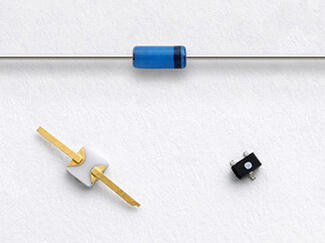
Noise diodes are the fundamental building blocks for analog noise systems. They are categorized for performance characteristics that enhance their broadband noise output and flat spectral response. All Maury noise diodes can deliver symmetrical white Gaussian noise and flat output power versus frequency*.
* Flatness and output power are dependent upon peripheral circuit characteristics
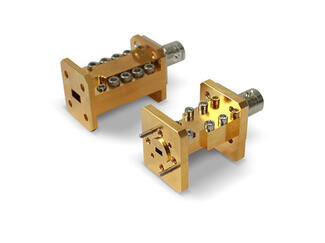
- Outstanding stability
- Fast switching speed
- Ripple-free response over standard waveguide bands
The NC5000A Series AWGN noise sources feature outstanding stability, switching speed, and ripple-free response over standard waveguide bands. The high stability of the NC5000A Series allows these units to be used in place of cumbersome gas tube noise sources.
Ripple in the output of noise sources has a direct effect on measurement accuracy, so Noisecom has tailored the response of the NC5000A Series so that ripple is minimized throughout the specified frequency range.

Maury Microwave
Website
Maury Microwave is a pioneering leader in the design and manufacture of precision RF and Microwave calibration, test & measurement, and modeling solutions that are powering global efforts toward a more secure, more connected, future.
Maury Microwave offers Measurement and Modeling Device Characterization Systems and Services including nonlinear passive, active and hybrid-active fundamental and harmonic load pull, non-50Ω X-Parameter modeling, pulsed IV Pulsed s-parameters and compact transistor modeling, and patent-pending ultra-fast/accurate noise parameters.