You design the future. We help you make it happen.
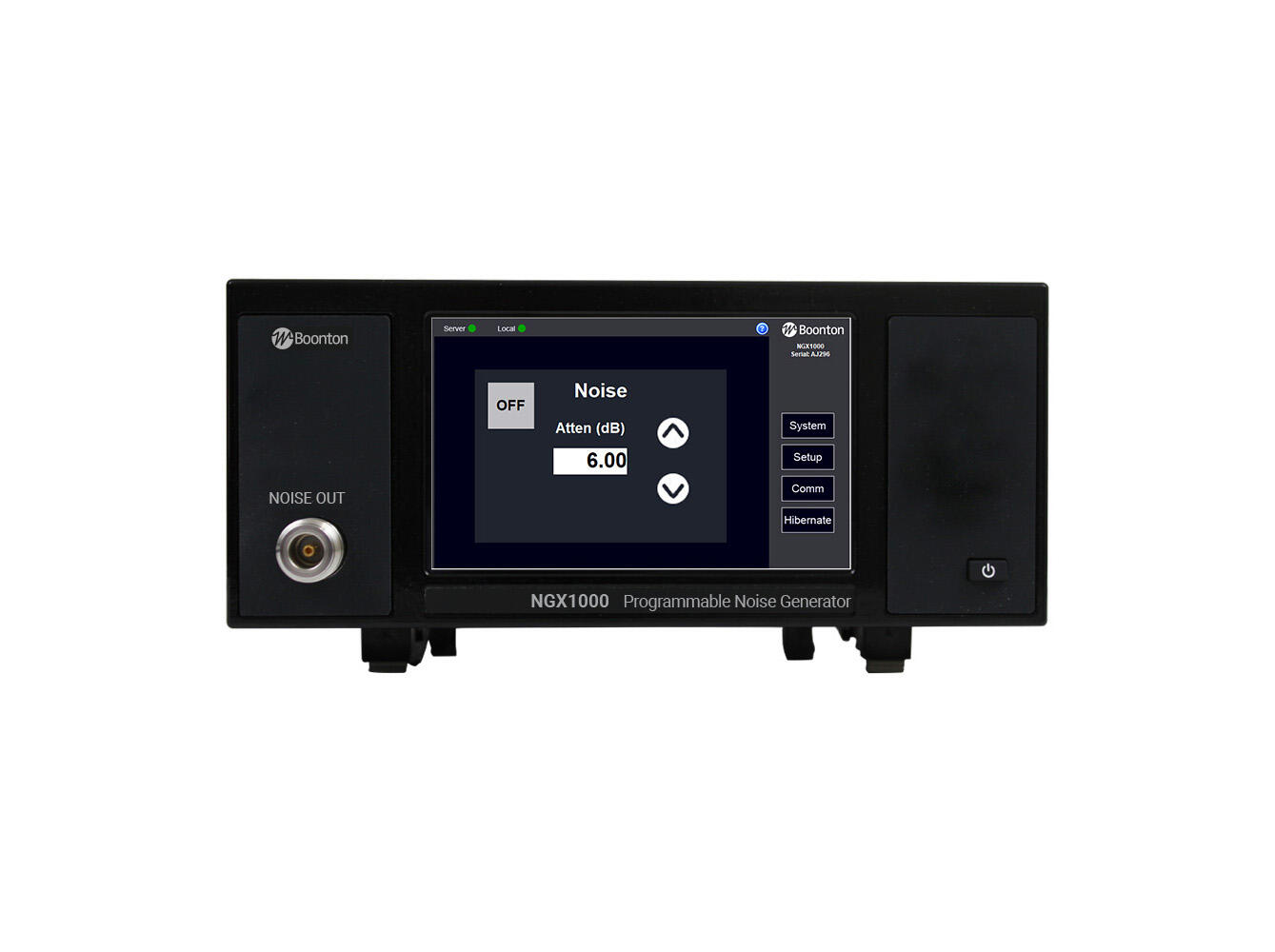
Maury MW - Programmable Noise Generators - NGX1000 Series
- 5” touch screen display
- Noise output through female N connector
- Ethernet connection for remote control
The NGX1000 programmable noise generator is a high performance, broadband additive white gaussian noise (AWGN) generator in an easy-to-use compact form factor. The streamlined user interface and flat menu structure provides a fast, simple way to add RF noise in a communications system to test reliability, robustness and performance.
All functionality of the generator is accessible through the 5” touch screen or via remote control through an ethernet connection delivering flexible, programmable noise generation for broad use in semiconductor, military, aerospace, satellite, medical and communications applications.
|
Output |
Output Power |
Attenuation |
|---|---|---|
|
White Gaussian noise |
Up to +10 dBm |
127 dB; 0.1 dB step size |
Accessories
- NGX1K-RMK: Full-width 19″ Rack Mount Kit (includes handles & hardware for mounting one or two generators)
- NGX1K-TCASE: Transit case
More Product Information
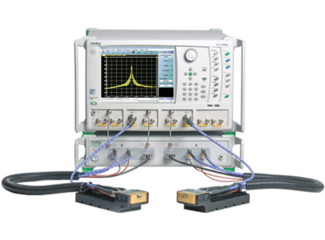
The VectorStar ME7838 Series broadband VNA offers the widest available single frequency sweep from 70 kHz to 110, (ME7838AX to 125), (ME7838EX to 125), to 145 GHz, and to 220 GHz with mmWave bands to 1.1 THz.
- The ME7838AX or ME7838EX version can easily be upgraded to 145 GHz and to 220 GHz
- All versions may be configured to include banded millimeter-wave modules up to 1.1 THz
- Industry-best calibration and measurement stability: 0.1 dB vs 0.6 dB over 24 hrs.
- All versions support the 3744x-Rx receiver for noise figure measurements, including the ability to characterize differential noise figure, to 125 GHz
- Compact, lightweight mmWave modules (0.6 lb vs 7+ lbs and 1/50 the volume) offer low cost installation on smaller probe stations.
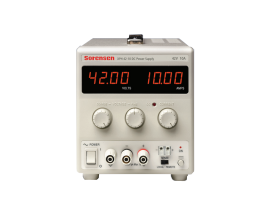
- Low Noise
- Excellent line/load regulation
- Remote sense
- Coarse and fine voltage controls
- Constant voltage or constant current operation with automatic crossover and mode indication
- Individual On/Off switch per output (not including fixed output)
- Variable ( 1.5V to 5V ) Auxiliary Output
- Shrouded socket-compatible with bare wire and shrouded safety plug connections up to 4 mm
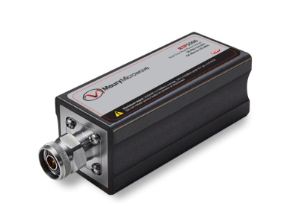
The overall performance of a power meter dependents on the power sensor employed. Maury has a variety of quality power sensors to meet virtually all applications. Maury has a complete line of Peak and Average power sensors up to 40 GHz for all of your fast rise time, wide bandwidth and wide dynamic range applications. In this document, browse through our large variety of advanced sensor solutions.
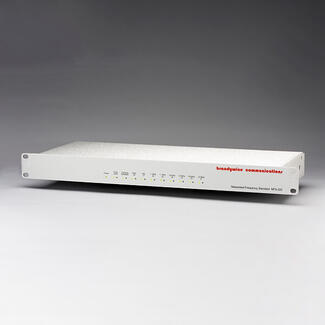
- High performance GPS disciplined Time/Frequency standard
- Ethernet Interface for management and control
- Network Time Protocol (NTP)
- Multiple 1PPS outputs with individual delay compensation
- Multiple Low Phase Noise 10MHz outputs with software programmable level
- Time Code outputs including Have Quick, IRIG A, IRIG B, IRIG E, IRIG G
- Sync to GPS or to Have Quick/1PPS per ICD-GPS-060
- Choice of internal disciplined OCXO or Rubidium Oscillator
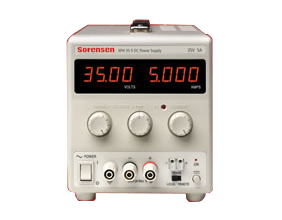
- Low noise
- Excellent line⁄load regulation
- Coarse and fine voltage controls
- Constant voltage or constant current operation with automatic crossover and mode indication
- Individual ON⁄Off switch per output (not including fixed output)
- Switchable 3.3V⁄5V output on triple output model
- Switchable remote sense (XPH 1810 and XPH 4210 models)
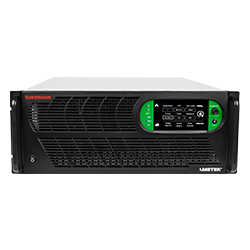
- Complete solution - battery test, simulation & solar array simulator software included
- Highest power density up to 37 kW in 4U rack height (9.25 kW/U)
- Fastest and cleanest power available (fastest transient response and low output ripple and noise)
- Universal 3-Phase AC Input accepts 180 VAC to 528 VAC
- Longest manufacturer-based reliability guarantee: 5-year warranty
- Parallel system power up to 1.2 MW
- Output voltage up to 2,000 V
- Bidirectional output current up to ±150 A, up to ±4,800 A in parallel
- True extended wide-range autoranging output
- Regenerative to 95%
- Color touch panel user interface
- Seamless transition between source and sink
- Built-in islanding detection
- Industry Leading Power Density – Up to 1700 Watts in 1U
- Standard Digital Interfaces – USB&RS232/485
- LXI Ethernet and Isolated analog interfaces
- Power Factor Correction-PFC and universal AC input
- “Green” Sleep Mode – Automatically “sleeps” after period of non-use
- Built in sequencing - Unload your system controller
- Programmable fold-back protection delay
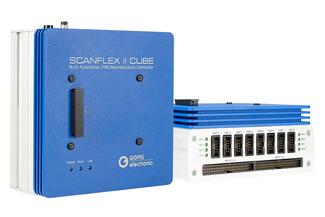
SCANFLEX II CUBE is the new generation modular JTAG/Boundary Scan controller. Based on the latest multi-core processors and FPGAs, SCANFLEX II CUBE opens new ways for the Embedded JTAG Solutions. The multifunctional architecture of the SCANFLEX II CUBE allows users to combine numerous technologies flexibly and with high performance on a single platform.
- 8 independent and parallel Test Access Ports (TAP) for up to 100 MHz
- Synchronized operation of embedded test, debugging and programming
- Programmable multifunctional 64 channel I/O signal unit
- Programmable TAP protocols for numerous processor debug interfaces
- Support of up to 31 parallel controlled SCANFLEX I/O modules
- Controllable via USB 3.0 and GBit LAN
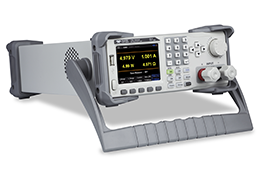
- Four operating modes: – CC, CV, CR, CP.
- Static, Dynamic and Sequence mode support.
- Built in Application Functions - Short Circuit Test, Battery Test Mode, CR-LED Mode, OCP and OPP Test.
- Provides a load of up to 300 Watts.
- Programmable and analog external control.

Maury Microwave
Website
Maury Microwave is a pioneering leader in the design and manufacture of precision RF and Microwave calibration, test & measurement, and modeling solutions that are powering global efforts toward a more secure, more connected, future.
Maury Microwave offers Measurement and Modeling Device Characterization Systems and Services including nonlinear passive, active and hybrid-active fundamental and harmonic load pull, non-50Ω X-Parameter modeling, pulsed IV Pulsed s-parameters and compact transistor modeling, and patent-pending ultra-fast/accurate noise parameters.