You design the future. We help you make it happen.
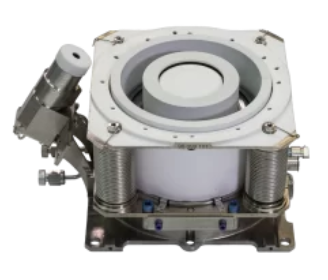
Safran DSI - EPS®1350 Electric Propulsion System
- Designed for Orbit-Topping and Station-Keeping
- 40% Weight Saving Convention Propulsion
- Excellent Thrust-to-Electrical Power Ratio
The EPS®1350 satellite propulsion system draws on Safran’s long experience with electric propulsion. It is designed for orbital transfer, station keeping and deorbiting satellites and other spacecraft. In particular, the EPS®1350 was the primary engine on ESA’s lunar probe, Smart-1, launched in 2003 by an Ariane 5 rocket. This mission was completed in September 2006.
Very High Performance
The major advantage of the EPS®1350 is of course its very high specific impulse, which allows significant weight savings versus platforms using conventional chemical propulsion. It also offers an excellent thrust-to-electrical power ratio, which enables reducing operating time or the number of thrusters needed.
In-Orbit Experience
The EPS®1350 amply demonstrated its capabilities during ESA’s Smart-1 probe’s mission from Earth orbit into orbit around the Moon: 5,000 hours cumulated operating time in space Four of these thrusters handle North/South station-keeping duties on the Alphasat satellite, launched in 2013. The EPS®1350 was selected by Space Systems Loral in 2016 and will be used on the company’s communications satellites for station-keeping, and for part of the orbit-topping operation.
More Product Information
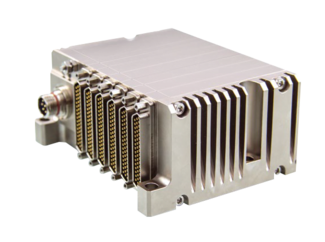
- Designed for Harsh Environment: High Shocks, High Vibration, EMI/EMC, -50/+105 Celsius, Waterproof, Lightning
- Ultra Compact and Generic: Generic Analog Module, 2x3" / 51x76 mm, from 1 to 16 modules per stack
- Best data Ever: 1000 ppm in extreme temperature range
- Easy to Configure: eZ software Suite
- Process & Command: Preprocess Data and Program Commands to External Systems
- Multi Format Output Stream: PCM Chapter 4, PCM Chapter 7, Low latency video, UDP output
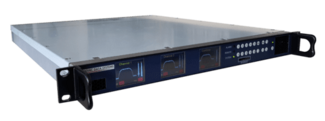
- STC and LPDC: Space Time Coding and LPDC supported, as well as many advanced features
- CH. 10 & IRIG218-20 Output: Easy and Modern UDP Data Spreading
- DQM/DQE: Embedded data Quality Metrics / Encapsulation compatible with Best Source Selector
- Front Panel Controls: 3 TFT Color Screen and Keyboard on Equipment, and Full Control from External KVM
- EQ+: Adaptive Equalizer for all Modulations, on Video and PCM outputs
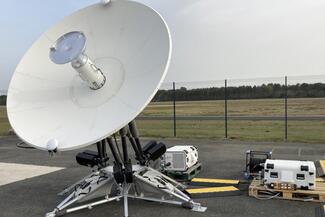
- Fast Set Up/Teardown: Single tool for mounting less than one (1) hour
- Field Maintenance: Made out of LRU parts for easy maintenance and repair
- MIL Standard Compliant: Easy handling
- Standard Shipping: Portable boxes shipped via FedEx, UPS, ...
- Designed for Field Operations: Air cooling free, auto North alignment, auto ground compensation
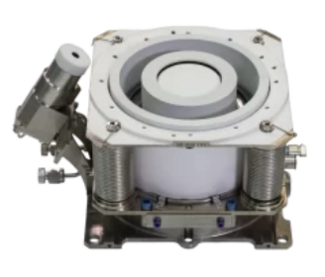
- Designed for Orbit-Topping and Station-Keeping
- 40% Weight Saving Convention Propulsion
- Excellent Thrust-to-Electrical Power Ratio
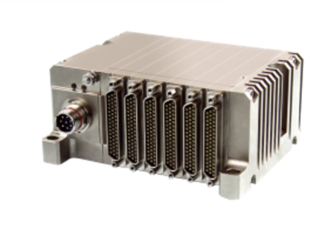
- Designed for Harsh Environments: – 50°C / +105°C, Waterproof, Shocks, Vibration, Lightning, EMI/EMC
- Ultra Compact: Generic analog module, 2×3’’ / 51×76 mm, from 1 to 16 modules per stack
- Best Data Ever: 500 ppm in extreme temperature range
- Easy to Configure: eZ software Suite, XML schema (MDL)
- INET Ready: UDP communication, IEEEE1588 synchronization, SNMP
- Multi Format Output Stream: PCM Chapter 4, Chapter 7, Chapter 10, UDP, IENA, DAR
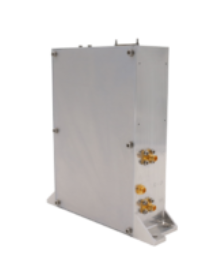
- Compact Design: Ideal for mini and micro satellites
- Long Lifetime: 7 year-lifetime in Low Earth Orbit missions
- COTS Design: Radiation tested and hardened, ITAR free
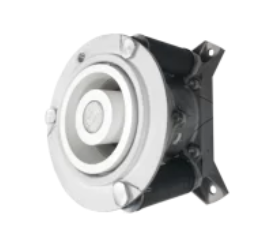
- Wide Range Power: 400 to 1,000 W
- Fuel Compatibility: Xenon (also compatible with Krypton)
- High Total Impulsive and Reliability Level
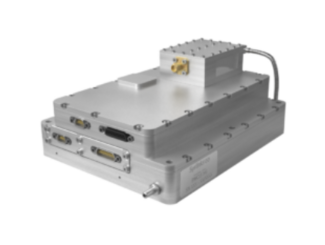
- Compact Design: Ideal for mini and micro satellites
- Long Lifetime: 7 year-lifetime in Low Earth Orbit missions
- COTS Design: Radiation tested and hardened, ITAR free
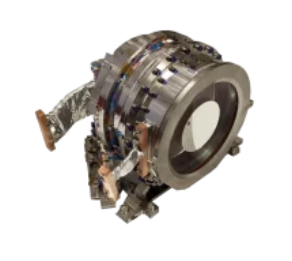
- Ultra-Low Swap: Saving launch and operational costs
- Wide FOV (Field of View): 6.3° x 4.3° / 54 x 36 km2 from a 500km orbit
Safran DSI
Safran DSI Testing & Telemetry provides complete, end-to-end solutions covering instrumentation, mission systems, onboard recording, and transmission, through to base stations for data monitoring and control. Our solutions are platform-agnostic and adaptable to customer mission needs.