You design the future. We help you make it happen.
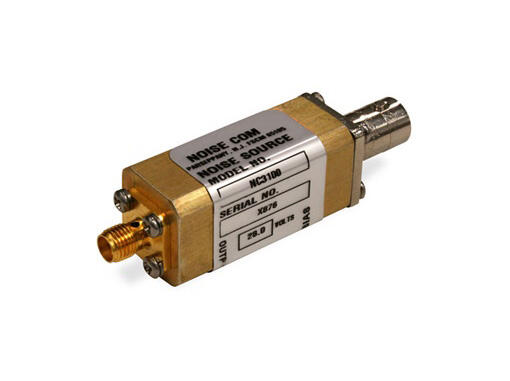
Maury MW - Calibrated Noise Sources - NC3000 Series
- Excellent temperature and voltage stability
- Units for noise figure meters feature 15.5-dB ± 0.75 dB ENR output
- High-output units for radar and satellite communications system testing feature output between 26 and 35 dB ± 1 dB ENR
The NC3000 Series calibrated coaxial AWGN sources are well suited for receiver testing, noise figure measurements, or applications that require broadband noise and fast switching times. Several models include output isolators, and voltage regulators that provide excellent stability over varying temperature and voltage ranges. The NC3000 Series includes the NC3100 units with 15 dB ENR output for noise-figure meters, and the NC3200 Series high-output noise sources with outputs between 26 and 35 dB ENR for radar and satellite communications system testing.
|
Noise Output Rise and Fall Times |
VSWR |
Noise Output Variation |
Input Power |
Noise Output |
|---|---|---|---|---|
|
Less than 1 µs |
Less than 3:1 |
Temperature Less than 0.01 dB/°C; Voltage -55° to +85°C |
+28 VDC 20 mA typical | 23 to 27 dB ENR |
Options
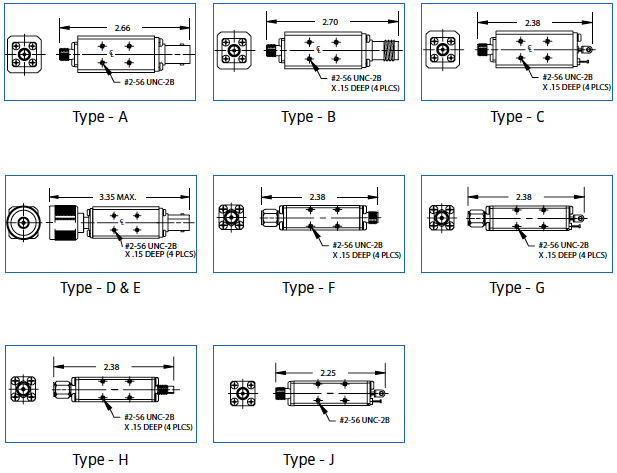
- Packages A, B, C, F, G, H, J can be supplied with threaded mounting holes
- Alternate sex of output connector
- +15 VDC input voltage (Not available on all sources, consult factory)
- +28 VDC regulation, stabilized output ± 2 V variation (Consult factory for package dimensions)
Applications
- Radar warning receivers (RWR)
- Built-in test equipment (BITE)
- Military aircraft
- Automotive Radar
- Ultra-low Latency Wireless Backhaul
- 802.11ad High-Speed Wi-Fi
More Product Information
- Calibration-grade metrology standards
- Used for VNA calibration and/or calibration validation
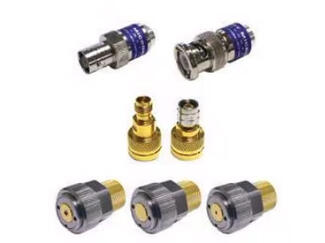
Fixed flush and fixed offset short circuit terminations (shorts) are used to establish reference planes in transmission systems and as key elements in the calibration of vector network analyzers (VNAs). Offset shorts can be used for banded calibrations of VNA. Those with the longest offset are often used to evaluate the calibration effectiveness of a VNA by measuring the effective source match after calibration.
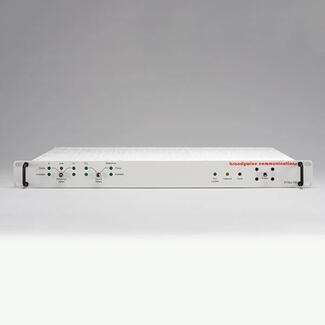
- Network Enabled Distribution Amplifier
- Low Phase Noise Reference Frequency Outputs
- Fault Alarm Output
- 1U 19″ Rack Mount
- Frequency Synthesizer Option
- Hitless Switching of Reference
- Programmable Amplitude
- Propagation Delay Compensation
- 10 MHz Standard, Other Frequencies Available
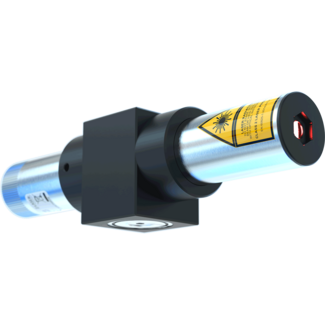
- Battery or rechargeable battery operation with polarity protection
- On/off switch
- Exactly calibrated red line
- 5mW output power
- Strong magnetic mount (100 N)
- Protection class IP40
The Z5A Belt-Aligner is a laser-based tool for the exact alignment of belt drives and pulleys. A compact line laser from the ZAT series is mounted in a specially designed holder and projects a red line that runs precisely parallel to the magnetic reference surface. Using the included target markers, drive and idler pulleys can be aligned quickly, safely, and without risk while at a standstill. Proven thousands of times in industrial use, the Z5A stands out for its ease of handling and reliable results. Delivered as a complete set with holder, measuring blocks, battery, and transport case, it offers everything needed for efficient belt alignment.
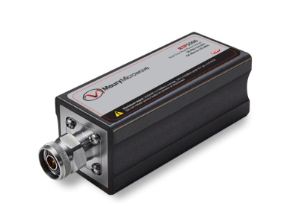
The overall performance of a power meter dependents on the power sensor employed. Maury has a variety of quality power sensors to meet virtually all applications. Maury has a complete line of Peak and Average power sensors up to 40 GHz for all of your fast rise time, wide bandwidth and wide dynamic range applications. In this document, browse through our large variety of advanced sensor solutions.
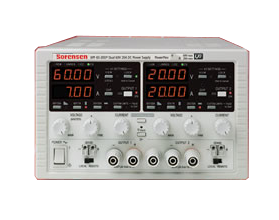
- PowerFlex design provides higher currents at lower voltages enabling one model to meet many different voltage/current requirements.
- Compact design for bench use or rack mounting (1/2 or 1/4 rack width)
- True analog controls with digital settings locking (S-Lock)
- Mixed-mode regulation with linear final regulation for low noise
- Dual models have isolated voltage tracking and synchronous on/off.
- P models have RS-232, USB, and LXI-compliant LAN interfaces plus duplicate rear terminals. GPIB Optional.
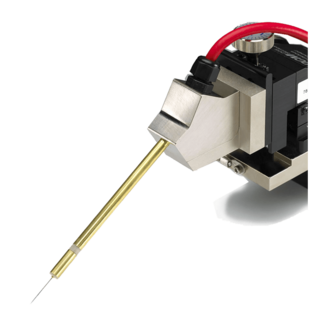
- Coaxial and triaxial measurements up to 10,000 V
- High-quality construction with low-noise electrical performance
- Replaceable probe tips in a variety of tip sizes
- Temperature range of of -60°C to 300°C
- Triaxial measurement ensures a much better understanding of device leakage in the off state
- Highly reliable, stable and repeatable measurements
- Integrally designed as part of a complete measurement solution
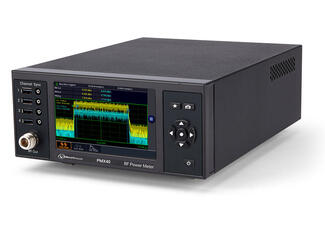
- Capture/display/analyze peak and average power
- Frequency range from 4 kHz to 40 GHz
- Industry-leading video bandwidth (195 MHz) and rise time (3 ns)
- Industry-leading 100,000 measurements per second
- Industry-leading 100 ps time resolution
- Synchronous multi-channel measurements (up to 4 channels)
- Sensors can be used as standalone instruments
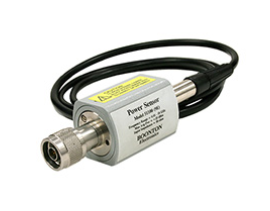
The overall performance of a power meter dependents on the power sensor employed. Maury has a variety of quality power sensors to meet virtually all applications. Maury has a complete line of Peak and Average power sensors up to 40 GHz for all of your fast rise time, wide bandwidth and wide dynamic range applications. In this document, browse through our large variety of advanced sensor solutions.
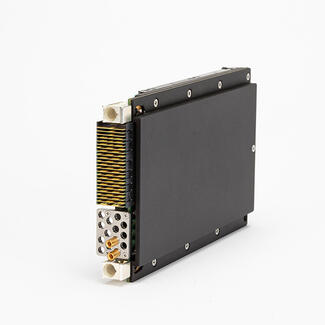
- SOSA Aligned
- 3U VPX Form-Factor
- Reduced SWaP applications
- Ruggedization Level 200
- 11 Radial Clock Outputs
- OpenVPX Backplane support for 1000BASE-KX or 10GBASE-KR
- Optional Chip Scale Atomic Clock (CSAC) Holdover
- Optional Low Phase Noise (LPN) Analog output
- Optional secure GPS (M-code)
- Optional Timecode I/O

Maury Microwave
Website
Maury Microwave is a pioneering leader in the design and manufacture of precision RF and Microwave calibration, test & measurement, and modeling solutions that are powering global efforts toward a more secure, more connected, future.
Maury Microwave offers Measurement and Modeling Device Characterization Systems and Services including nonlinear passive, active and hybrid-active fundamental and harmonic load pull, non-50Ω X-Parameter modeling, pulsed IV Pulsed s-parameters and compact transistor modeling, and patent-pending ultra-fast/accurate noise parameters.