You design the future. We help you make it happen.
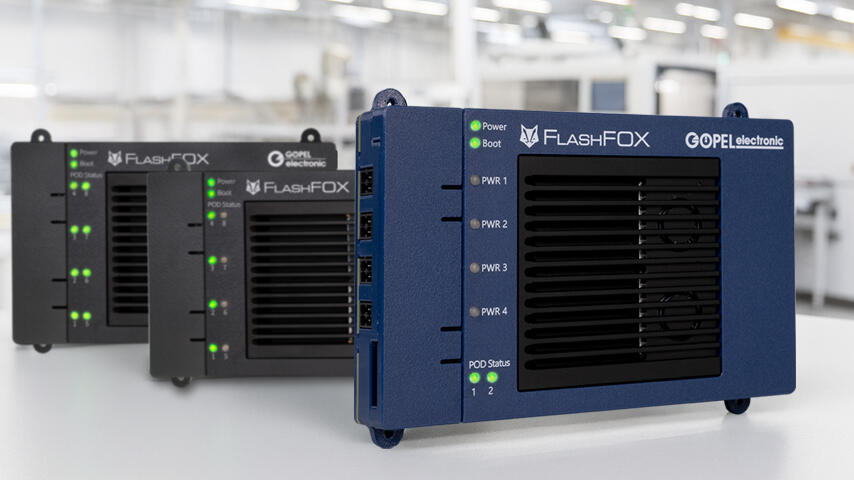
Goepel - FlashFOX Stand-alone production programmer for Embedded In-System Programming (ISP)
- support of many programmable devices, e.g. eMMC, NOR and NAND, CPLDs, FPGAs
- programming interfaces e.g. SPI, SWD, I2C, JTAG, UART, DAP
- support of data streaming for flexible programming data handling
- real parallel high-speed programming
- FlashFOX® master unit with up to 8 high-speed programming channels to the POD
- very compact POD unit for easy integration into ATE systems
- simple adaptation to existing systems on the hardware side
- API available for easy software integration in existing systems
- suitable for industrial use in 24/7 operation
- anti-piracy protection (security)
Production Programmer (embedded ISP) for Microcontrollers, Flash Components and PLD/FPGA
Are you looking for a stand-alone programming solution, but can do without overhead testing?
FlashFOX is a standalone production programmer that enables the fast and secure in system programming (ISP) of microcontrollers, flash memories, programmable logic devices (PLDs), and field-programmable gate arrays (FPGAs) from a wide range of manufacturers. Designed for industrial use in electronics production, the flash programmer is an easy-to-use tool for development, debugging and programming of microcontrollers.
Thanks to its robust hardware, intuitive user interface, and extensive functions, the standalone programmer can be seamlessly integrated into existing production processes. Its flexible interfaces and wide range of supported programmable devices enable versatile use — from the laboratory bench to the production line.
Despite its compact design, FlashFOX® achieves the highest programming speeds. Both in the laboratory and production, the FlashFOX® works time and cost-efficiently because up to eight different DUTs can be programmed and validated simultaneously.
The system design consists of a compact master unit and extremely small remote PODs that ensure maximum signal integrity despite of high distances. Control is via hardware commands (stand-alone via ATE interface) or a host system. FlashFOX® serves different debug interfaces (such as JTAG, SWD or DAP) or communication interfaces (SPI, I²C or UART) on the DUT side. Dedicated programming drivers ensure the shortest possible programming times.
|
FlashFOX 8 |
FlashFOX 8/X4 |
FlashFOX 2 |
|
|---|---|---|---|
|
Operating Voltage |
5 V via power supply | 15 V via power supply | |
|
Control Interfaces |
Gbit LAN, WLAN, USB 3.0, Serial interface (R232), ATE interface | ||
|
Bus Frequency |
100 MHz |
||
|
Number of POD Slots |
8 |
4 (upgrade at 8 available) | 2 |
|
Number of Power Supply |
0 |
0 | 4 |
|
POD Modules |
POD02/S(R) POD022/SR POD122/S(R) POD422/S(R) |
||
|
Integrated Technologies / Formats |
VarioTAP, X-BUS, SCANFLEX, SVF, JAM/STAPL |
||
JavaScript Support
Implementation of highly flexible and customized programming sequences using JavaScript Programming procedures can be just as flexible and complex as the PCBA itself. Multiple actions often need to be carried out in succession and in dependence on each other.
The FlashFOX is the first production programmer to support the execution of JavaScript, which also forms the basis for internal procedure processing. With the help of a graphical user interface and generators, the JavaScript is automatically generated.
This allows users to select, proprietaries and sequence predefined actions, such as a chip erase, program or verify. But the use of JavaScript offers even more advantages. Scripts can be adapted, added to or programmed manually from scratch at any time. All the possibilities of JavaScript are available to the user. With the help of variables, loops and control structures, such as IF commands, complex and very flexible processes can be created. Even the manipulation of programming data is possible at runtime.
JavaScript also allows the integration of your own libraries to expand the possibilities. Thus, the execution of JavaScript allows the FlashFOX to implement very flexible and customised programming sequences.
Embedded In-System Programming (ISP)
As an alternative to on-socket programming or pre-programmed microcontrollers/parallel memories, with embedded ISP the device is programmed in the already installed state (in the system). This means that no mechanical stress is placed on the circuit and firmware updates are simplified.
Securing the PCBA prior to programming
Often, numerous constraints must be met before memory chips and UUTs can even be successfully addressed. This starts with extensive power-up sequences. With the help of a microcontroller, CPLDs or FPGAs, different voltage domains must be switched on and monitored one after the other. Without observing the correct switching sequence, timings or safety mechanisms, the desired functions could be compromised or even damage the DUT.
Memory devices are often protected by complicated security circuits. This is to prevent the wrong data from being written or content from being read in the first place. This is a major challenge for programmers, because successful programming is not possible without direct control over all the signals necessary to switch on the PCBA correctly.
The FlashFOX solves this problem by implementing a SVF execution. Boundary Scan Shift Vectors are stored in an SVF file. This allows Boundary Scan operations to be performed and signals to be set, read and verified.
In this way, design-specific and complex power-up sequences and security mechanisms can be implemented. SVF files are standardised and can be generated from a variety of development environments (including GÖPEL electronic's SYSTEM CASCON).
More Product Information
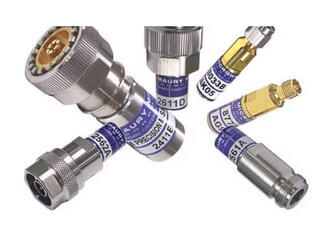
- Calibration-grade metrology standards
- Used for VNA calibration and/or calibration validation
Precision standard mismatches are fixed coaxial terminations, which are used to introduce a known VSWR into a 50 ohm transmission system. These mismatches are extremely useful in a wide variety of applications and are quick and easy to use. They can be used to calibrate swept reflectometers, verify network analyzer calibration, establish impedance references in TDR measurements.
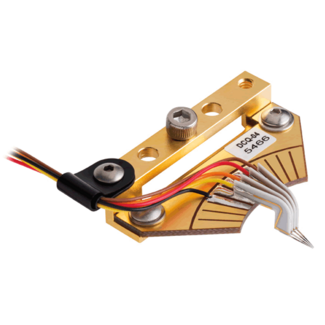
- Power bypass inductance: 8 nH
- Standard DCQ probes have flat tip needles available in nickel-plated tungsten or BeCu with diameters of 0.75 mil, 1.0 mil and 1.5 mil.
- Supports collinear and non-standard needle configurations
- Up to 16 DC for standard; maximum of 24 DC for custom
- Ideal for probing the entire circuit for functional test
- DC probes can provide power or slow logic to circuit under test
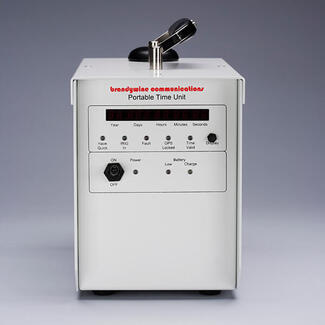
- 16 channel GPS SPS receiver (standard)
- IRIG B Time Code (standard)
- HaveQuick/1PPS from external GPS receiver (standard)
- Temperature Compensated Crystal Oscillator (TCXO) – option
- Oven Controlled Crystal Oscillator (OCXO) standard
- Atomic Rubidium Oscillator – option
- 1PPS 1 Pulse Per Second Signal Time Mark
- Have Quick Time Code
- IRIG B Time Code
- NTP
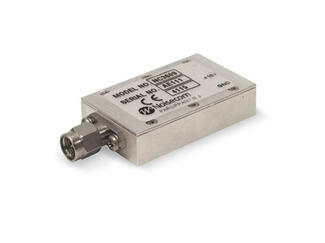
- High ENR
- Wide frequency range
- Custom frequencies available
The NC3600 Series coaxial noise sources are an excellent choice for applications requiring high ENR, such as ATE, radiometer, and radar systems.
An SMA male connector is standard for the RF output and feed thrus for bias input. SMA female is an option. Custom frequencies and flatness available. Contact the factory with your request.
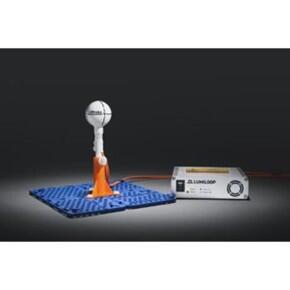
The LSProbe 1.2 Variant E Field Probe is a high-speed, high-accuracy, and high-dynamic range electric-Field probe.
- Its standard frequency range of 10 kHz – 8.2 GHz. 1,000 V/m
- Best-in-class compensation of linearity, frequency, and temperature guarantees accurate measurements from less than 0.1 to at least 1,000 V/m.
- A dynamic range of 100 dB is achieved for many frequencies, enabling Field measurements at more than 10,000 V/m.
- Customized high Field-strength „X“-variants, supporting up to 30,000 V/m and a damage level of 100,000 V/m, are available upon request.
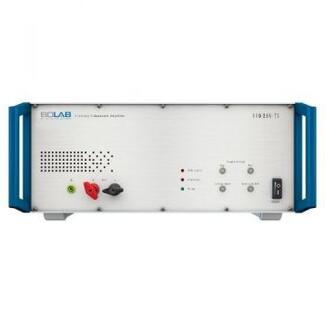
- DC - 200 kHz bandwidth DC
- MHz (small signal -3 dB)
- Output voltage ±75 Vpk
- Rise / fall time 100 V/µs
- USB interface standard, LAN optional
- Analog control input 0 ... ±10 V for control of voltage and current
- Monitor outputs for measured voltage and current values (not all models)
- Modularly extensible via master-slave mode
- Parallel and Series Connections for two or more units
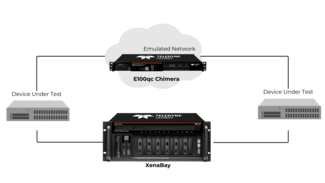
E100 Chimera can impair Ethernet traffic at 5 speeds up to 100Gbps to emulate real-world network behavior
- E100 Chimera supports a broad range of impairments (latency/jitter, packet & port impairments, flexible distributions, BW shaping etc)
- True wire-speed impairment @ 100Gbps (plus 50 / 40 / 25 & 10Gbps) NRZ and PAM4
- Ease of use – E100 Chimera is a stand-alone impairment tool that integrates seamlessly with Xena’s traffic generator, letting you speed up your work flow by using the same SW to both generate and impair Ethernet traffic.
- Highest port density in the industry – plus you can reserve individual port-pairs without blocking access to the others
- Setting up custom impairment distributions is a breeze
- Powerful, easy-to-use automation & scripting options
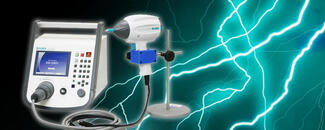
EMC test equipment to evaluate the resistibility of electronic devices and components when energy charged on a human body or object is discharged to the electronic devices and components. NoiseKen brand ESD simulator is available to see malfunctions or function declines of electronic equipment for appropriate evaluations compliant with IEC 61000-4-2 Ed.2 Test Standard, ISO 10605 Ed.2 Test Standard & ISO 10605 Ed.3 Test Standard.
The ESS-S3011A features a function which enables the user to pre-program test settings to minimize setup errors as well as having the unit be incorporated into a remote or autonomous testing setup. Another feature that sets apart NoiseKen ESD guns to that of competitors is the discharging gun separation design which helps achieve the lightweight.
For conventional ESD guns, that have generators that are inseparable from the gun, you may experience having to replace the whole unit even only when certain parts of the unit are broken. However, with the NoiseKen’s separation design, replacement parts can be minimized to lower the running cost.
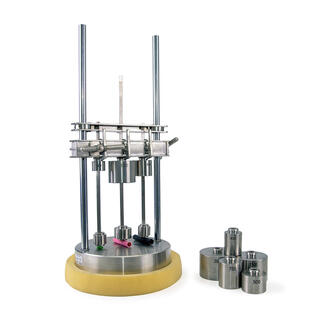
- Device and operation are according to the standard IEC 60811-506 (IEC 60811-1-4) point 8.5
- Case set offers all required weights for the test
- Easy operation
- Very robust and solid construction
- Steel impact piece included
- Up to 3 Samples can be tested simultaneously
- Device suitable for positioning in a cold chamber - Product No.: 402.0020.02

Goepel Electronics
Website
With advanced testing and inspection systems for electronic assemblies and printed circuit boards, GÖPEL electronic helps discerning customers from various industry sectors to maintain their commitment to quality.
The company’s wide range of technology provides a basis for finding manufacturing defects at every stage of the product life cycle – from design to end-of-line.