You design the future. We help you make it happen.
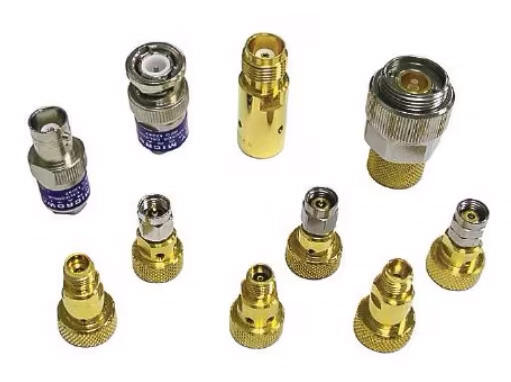
Maury MW - VNA Calibration Standard - Open Circuit Termination Series
- Calibration-grade metrology standards
- Used for VNA calibration and/or calibration validation
Shielded, coaxial opens are used in the calibration of vector network analyzers to provide a nominal 180° phase offset from a compatible reference short over a wide range of frequencies. At these frequencies, open circuit terminations are inherently imperfect. Shielding the open essentially eliminates radiation loss, but creates a residual frequency-sensitive capacitance. An accurate knowledge of the open’s effective capacitance is essential to an accurate calibration of the analyzer. Maury opens are characterized for effective capacitance versus frequency by means of a fourth order polynomial curve fit, and the nominal capacitance coefficients are provided with each unit.
|
Frequency Range |
Reflection Coefficient |
|---|---|
| DC to 50 GHz | 0.98 to 0.995 |
More Product Information
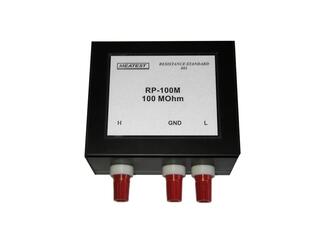
Series of single resistance, capacitance and inductance decadic standards for calibration of ohm meters, LCR meters and multimeters.
- Traceable, accurate and stable
- Low time constant
- Low temperature coefficient
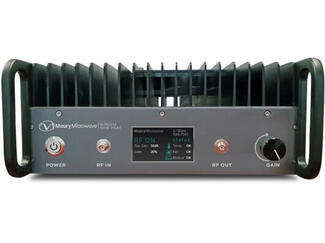
Not all amplifiers are created equal, so how can you be certain that an amplifier will work for your needs? You deserve to be confident that the amplifiers used with your test-and measurement lab benches will meet the requirements of your specific applications, are reliable, and are equally well-supported pre-and post-sale. When it comes to application expertise, reliability and support, there is no company that does it better than Maury.
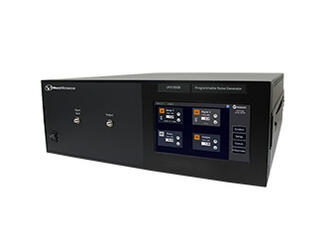
- Output White Gaussian noise
- Output power up to +30 dBm
- 127 dB of attenuation; 0.1 dB step size
- Units > 2 GHz have total attenuation of 79.9 dB
- Low distortion signal path
- Power 115 VAC, 60 Hz
- Noise attenuator accuracy: ±0.2 dB or 0.5% at 1 – 500 MHz ±0.2 dB or 1% at 0.5 – 1.0 GHz ±0.3 dB or 2% at 1 – 2 GHz
- Standard connectors SMA female
- 7” touch screen display
- Dimensions: 17.25 in. wide x 6.50 in. including feet, high x 19.50 in. deep
- Removable hard drive for added security
- Operating Temperature: -10° to +65°C
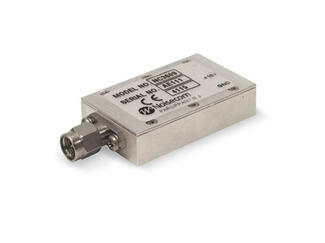
- High ENR
- Wide frequency range
- Custom frequencies available
The NC3600 Series coaxial noise sources are an excellent choice for applications requiring high ENR, such as ATE, radiometer, and radar systems.
An SMA male connector is standard for the RF output and feed thrus for bias input. SMA female is an option. Custom frequencies and flatness available. Contact the factory with your request.
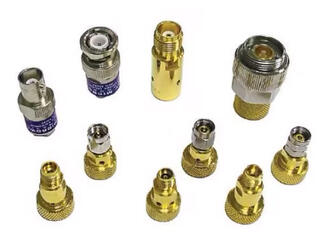
- Calibration-grade metrology standards
- Used for VNA calibration and/or calibration validation
Shielded, coaxial opens are used in the calibration of vector network analyzers to provide a nominal 180° phase offset from a compatible reference short over a wide range of frequencies. At these frequencies, open circuit terminations are inherently imperfect. Shielding the open essentially eliminates radiation loss, but creates a residual frequency-sensitive capacitance. An accurate knowledge of the open’s effective capacitance is essential to an accurate calibration of the analyzer. Maury opens are characterized for effective capacitance versus frequency by means of a fourth order polynomial curve fit, and the nominal capacitance coefficients are provided with each unit.
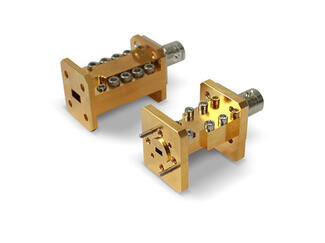
- Outstanding stability
- Fast switching speed
- Ripple-free response over standard waveguide bands
The NC5000A Series AWGN noise sources feature outstanding stability, switching speed, and ripple-free response over standard waveguide bands. The high stability of the NC5000A Series allows these units to be used in place of cumbersome gas tube noise sources.
Ripple in the output of noise sources has a direct effect on measurement accuracy, so Noisecom has tailored the response of the NC5000A Series so that ripple is minimized throughout the specified frequency range.
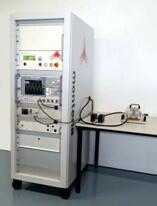
- Automatic calibration for the whole test frequency range
- Application of all test frequencies automatically. The level can be selected or automatic.
- NO need to manually configure the measurement equipment
- NO need to manually integrate the transfer function of probes and attenuators
- Generation of test reports: NO need to record all values read from the measurement equipment
- Generation of calibration reports: NO need to record all calibration setting parameters
- Rack together and add CS101, CS109, and RS101 (sections 18, 19, and 20 of the RTCA DO-160G are also available.)
Measurement Accuracy
- Best solution for high accuracy IV/CV, low-noise and 1/f measurements with PureLine, AutoGuard and next generation MicroChamber technologies
- Minimize AC and spectral noise with effective shielding capability
- Achieve unsurpassed RF/mmW measurement and calibration accuracy with integrated RF tools and WinCal
- Shortest signal path test integration for accurate, thermally stable, and low-error data collection
See "Specifications & Details" tab for more key features
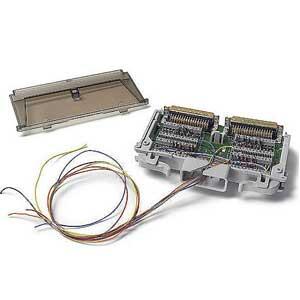
Transcat is your source for premium used test & measurement equipment. We carefully refurbish used test equipment and subject it to an uncompromising calibration and certification process to ensure it is ready for operation on day one. Our 6 month warranty guarantee you a successful used instrument purchase.

Maury Microwave
Website
Maury Microwave is a pioneering leader in the design and manufacture of precision RF and Microwave calibration, test & measurement, and modeling solutions that are powering global efforts toward a more secure, more connected, future.
Maury Microwave offers Measurement and Modeling Device Characterization Systems and Services including nonlinear passive, active and hybrid-active fundamental and harmonic load pull, non-50Ω X-Parameter modeling, pulsed IV Pulsed s-parameters and compact transistor modeling, and patent-pending ultra-fast/accurate noise parameters.